Algorithmic Design ChoicesAlgorithmic Design Choices and Allocation Equity
A Causal Simulation Study of Care Management Targeting
Care management programs increasingly rely on prediction algorithms to decide which patients receive limited healthcare resources. Because these algorithms are typically trained to predict future utilization or cost, patients whose utilization is suppressed by structural barriers may be systematically underidentified. Using linked electronic health record and participant survey data from the NIH All of Us Research Program, this study treats three modifiable design choices (selection threshold, feature set, and training objective) as interventions on the allocation system's causal graph and evaluates their effects on allocation equity. Training objective variation produced the strongest and most consistent equity effects; threshold adjustment produced almost none. An access-independent equity benchmark built from self-reported health status revealed disparities that utilization-based metrics could not detect.
Introduction
Health systems use prediction algorithms to identify patients for care management programs, which provide intensive services to those expected to have high future healthcare costs and needs1. Because program capacity is limited, these algorithms function as allocation systems: model output determines who is prioritized for outreach2.
These algorithms are trained on what health system data records, which means future utilization or cost. That substitution carries an assumption, namely that patients who need more care use more care. Obermeyer and colleagues showed in 2019 that the assumption fails when structural barriers suppress utilization, and that a widely deployed commercial algorithm assigned lower risk scores to Black patients with equivalent health burden as a result3.
Most work since has documented that such disparities exist4,5. Less has examined the design decisions that produce them: what the model is trained to predict, which variables it is permitted to use, and where the selection cutoff sits. These are typically treated as technical choices, resolved by predictive performance and program capacity rather than by their consequences for who receives care. This project asks what happens to allocation equity when each of them is varied deliberately.
Data
This project uses the All of Us Research Program Registered Tier dataset (CDRv8 - R9), accessed through the Researcher Workbench. All of Us links electronic health record data from participating health systems with participant-reported survey data collected at enrollment, which allows clinical utilization patterns to be paired with self-reported health status and socioeconomic characteristics.
The analytical cohort comprised 201,216 adults aged 18 or older with at least one inpatient, emergency department, or outpatient visit during a two-year baseline period (2017–2018) who completed the enrollment survey. Utilization was measured as the count of distinct visit dates across encounter types.
The cohort reflects the program's deliberate oversampling of historically underrepresented populations: 51% White, 21% Black, 18% Hispanic, 2.9% Asian, with 37% reporting annual household income below $35,000. That composition is a limitation for generalizability and a strength for studying disparity, since the subgroups most affected by access barriers are well represented.
Methods
Three prediction models (logistic regression, random forest, XGBoost) were trained to predict high utilization in the follow-up year, defined as membership in the top quartile of total visit counts, with a fixed 20% selection threshold applied to flag patients for care management.
Each design choice was then varied one at a time while holding the others fixed, framed as a formal do-operation on the allocation system's structural causal model. Simulation 1 applied three selection thresholds (10%, 20%, 30%) without retraining. Simulation 2 retrained all models under four feature sets, including conditions that excluded prior outpatient visits or all prior utilization. Simulation 3 retrained all models under four training objectives, including self-reported general health status in place of utilization.
Equity was assessed two ways. The primary metric was equal opportunity difference, computed from false negative rates by subgroup6. The secondary metric, and the methodological contribution of the project, was the allocation rate conditional on need: among participants reporting fair or poor general health status, the proportion flagged by the model. Because self-reported health does not depend on whether care was accessible, this benchmark captures disparities that utilization-based metrics cannot7.
Oaxaca-Blinder decomposition was applied to the predicted allocation log-odds to identify which predictors contributed most to the Black-White gap8.
Results
Before any model was fit, utilization understated reported health burden for disadvantaged groups. Black and Hispanic participants reported fair or poor health at higher rates than they were classified as high utilizers; White participants showed the opposite pattern. The same divergence appeared by insurance type, most sharply among Medicaid and uninsured participants.
All three models produced similar disparities at baseline, which suggests the pattern reflects structure in the training data rather than model-specific behavior. The decomposition identified prior outpatient visits as the dominant contributor to the Black-White gap, with emergency department utilization partially offsetting it. That contrast tracks how the two encounter types relate to access: outpatient visits are discretionary and access-sensitive, while emergency department visits are largely need-driven.
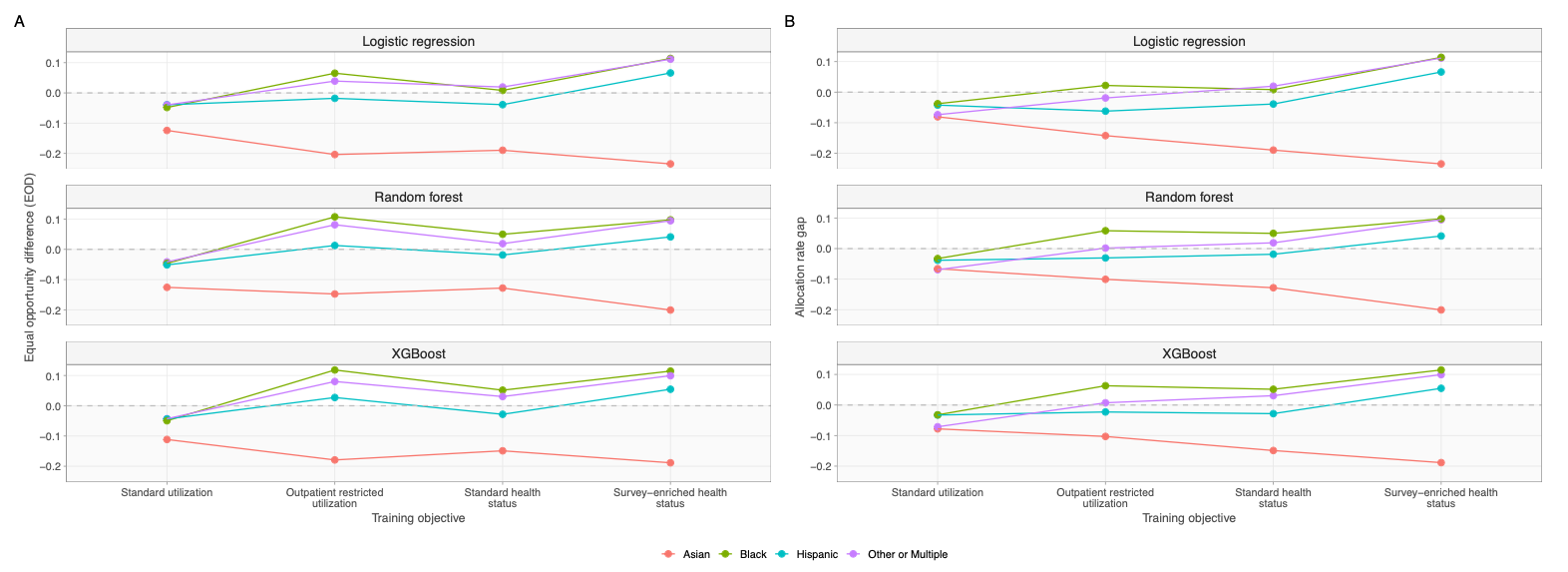
Varying the selection threshold did almost nothing. Disparities persisted at every operating point, and loosening the threshold worsened equity for uninsured participants. Feature set changes produced mixed, group-specific effects: removing prior outpatient visits brought Black-White EOD to near zero, consistent with the decomposition, but worsened disparities for Asian and Hispanic participants at substantial accuracy cost.
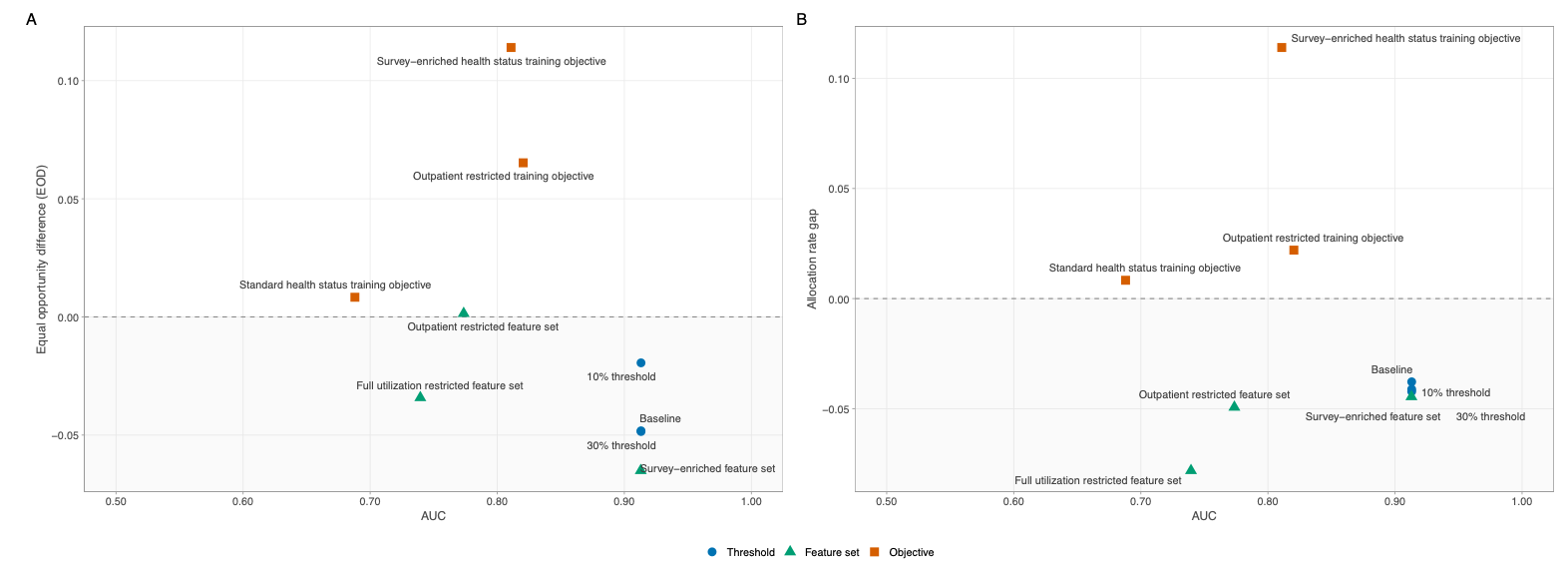
Changing the training objective produced the largest and most consistent effects. Predicting self-reported health status instead of utilization brought racial disparities close to parity, and a survey-enriched version reversed their direction. Both came at an accuracy cost, from 0.913 AUC under the standard objective to 0.688 under health status, partially recovered to 0.811 when socioeconomic predictors were added.
The same objectives shift the picture by insurance type, where the widest gap of any subgroup appeared: an equal opportunity difference of -0.148 for uninsured participants.
Read against model accuracy, the equity gains carry a price. Plotting every simulation condition against AUC places the conditions closest to parity well below the 0.913 AUC of the standard utilization objective.
Limitations
Several limitations apply. The All of Us cohort is not representative of the populations served by deployed care management programs. The decomposition covered only the Black-White comparison. Equity estimates were not accompanied by bootstrap confidence intervals, and estimates for Asian and uninsured participants rest on small subgroups (2.9% and 0.7% of the cohort), so those patterns should be read with caution.
Survey variables were collected at enrollment rather than annually, which introduces temporal misalignment between the benchmark and the utilization it is meant to evaluate. Design choices were also varied one at a time, so interactions between them remain untested.
Conclusions
Allocation equity in care management targeting is not a fixed property of a deployed model. It is a consequence of design decisions made during development, and the decisions differ substantially in how much they matter. Changing what the algorithm is trained to predict shifted equity outcomes more than changing its inputs or its cutoff, which follows from where the problem originates: structural barriers to access are reflected in the utilization outcome itself, not only in the variables that predict it.
The practical implication is that equity belongs in the design phase rather than in post-deployment correction, and that evaluating it requires a measure of health need that does not depend on whether care was accessible. Both the simulation approach and the access-independent benchmark are transferable to other algorithmic allocation settings.
We gratefully acknowledge All of Us participants for their contributions, without whom this research would not have been possible. We also thank the National Institutes of Health's All of Us Research Program for making available the participant data examined in this study.
References
- 1.de Ruijter, U. W., Kaplan, Z. L. R., Bramer, W. M., Eijkenaar, F., Nieboer, D., van der Heide, A., Lingsma, H. F., & Bax, W. A. (2022). Prediction models for future high-need high-cost healthcare use: A systematic review. Journal of General Internal Medicine, 37(7), 1763–1770. ↗ link
- 2.Powers, B. W., & Chaguturu, S. K. (2016). ACOs and high-cost patients. New England Journal of Medicine, 374(3), 203–205. ↗ link
- 3.Obermeyer, Z., Powers, B., Vogeli, C., & Mullainathan, S. (2019). Dissecting racial bias in an algorithm used to manage the health of populations. Science, 366(6464), 447–453. ↗ link
- 4.Paulus, J. K., & Kent, D. M. (2020). Predictably unequal: Understanding and addressing concerns that algorithmic clinical prediction may increase health disparities. npj Digital Medicine, 3(1), 99. ↗ link
- 5.Cary, M. P., Zink, A., Wei, S., Olson, A., Yan, M., Senior, R., Bessias, S., Gadhoumi, K., Jean-Pierre, G., Wang, D., Ledbetter, L. S., Economou-Zavlanos, N. J., Obermeyer, Z., & Pencina, M. J. (2023). Mitigating racial and ethnic bias and advancing health equity in the development, evaluation, and deployment of clinical algorithms in healthcare: A scoping review and implications for policy. Health Affairs, 42(10), 1359–1368. ↗ link
- 6.Hardt, M., Price, E., & Srebro, N. (2016). Equality of opportunity in supervised learning. arXiv preprint.
- 7.Fishman, J., McLafferty, S., & Galanter, W. (2018). Does spatial access to primary care affect emergency department utilization for nonemergent conditions? Health Services Research, 53(1), 489–508. ↗ link
- 8.Rahimi, E., & Hashemi Nazari, S. S. (2021). A detailed explanation and graphical representation of the Blinder-Oaxaca decomposition method with its application in health inequalities. Emerging Themes in Epidemiology, 18, 12. ↗ link